About 331 minutes
Timaeus — Key Ideas to Explore
Political Philosophy
76,052 recorded words. 16 minutes difference from this book's estimate.
View Gutenberg source #1572
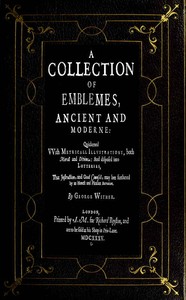
Before opening A Collection of Emblemes, Ancient and Moderne Quickened With Metrical Illustrations, Both Morall and Divine, Etc. — Story, Setting & Ideas, the edition data offers a quick orientation: 79,728 words, 5 hr 47 min estimated reading time, and 38 detected text sections.
The text analysis averages about 28.1 words per sentence, while the detected sections provide another way to judge how the source is divided.
Project Gutenberg metadata also associates the work with “Emblems,” connecting these edition facts with the source record’s subject description.
Explore this collection
These alternatives are selected using recorded categories and estimated reading time.
About 331 minutes
Political Philosophy
76,052 recorded words. 16 minutes difference from this book's estimate.
View Gutenberg source #1572About 326 minutes
Political Philosophy
74,829 recorded words. 21 minutes difference from this book's estimate.
View Gutenberg source #38582About 403 minutes
Political Philosophy
92,543 recorded words. 56 minutes difference from this book's estimate.
View Gutenberg source #55618Search stored excerpts and compare books → Choose by your preferences →
Choices use stored catalog measurements. Estimates vary with reading speed. A shared category is a catalog label, not a claim that two books have the same argument or literary quality.
Search reads excerpt text stored with this catalog and links to its associated Gutenberg record. The connection is stored in the site database; this tool does not recheck that every excerpt is word-for-word identical to that external record. Excerpt search does not cover every chapter and does not verify historical publication dates.
Catalog snapshot checked: 2026-09-26. Coverage: 98 public books, 98 available source excerpts.
Calculated from edition completeness, EPUB availability, text structure and catalogue metadata. Not a user rating.
Total of 100 points, scaled to a 2.5-5.0 range. Editions with an empty description or a missing EPUB file are not scored.
Public-domain source text
The source text is kept in the dedicated reader, separate from this catalogue record and its commentary.
George Wither's A Collection of Emblemes, Ancient and Moderne (1635) is built on a repeating three-part structure: a Latin motto engraved around the emblem, a copperplate illustration, and a metrical illustration in English verse. This format, borrowed from continental emblem books, gives each page a distinct visual and verbal rhythm. The opening frontispiece, as Wither explains, was a happy accident—the engraver misunderstood the design, yet Wither found the resulting 'Errors and Confusions' fitting, inviting readers to 'pumpe the secrets' themselves. This playful attitude toward interpretation sets the tone for the whole collection.
One of the most striking recurring images is the gryphon, a hybrid beast combining a fowl and a beast, which Wither interprets as representing 'the Vertues, both of Body, and of minde.' In Illustration VI of Book 3, the gryphon supports a stone, which signifies 'the firme abiding, and the solidnesse / Of all true Vertues,' while a 'long-winged Ball' linked to the stone implies 'the gifts of changing Fortune.' The emblem concludes that when men are guided by such mixed virtues, good fortune cannot be separated from them. This image recurs thematically throughout the book, often paired with admonitions against murmuring or envying others' success. Wither uses the gryphon to argue that virtue, not luck, is the true foundation of prosperity.
In Illustration VII of Book 3, Wither employs a garden metaphor: pleasant flowers, though planted and tended by a gardener, ultimately draw their virtue from the sun. 'For, lost were all his Travaile, and his praise, / Vnlesse that Planet cheare them with his rayes.' This image becomes a vehicle for theological reflection on human effort and divine blessing. Wither extends the metaphor to all human endeavors—building, guarding a city, sowing corn—insisting that God must bless the work or it is fruitless. The emblem warns against pride in one's own flourishing, reminding readers that even the most beautiful flower may wither 'e're another houre.' The garden thus serves as a microcosm of the moral life, where human agency and divine grace are intertwined.
Wither does not shy from doctrinal controversy. In a later emblem, he catalogues three erroneous sects: those who think themselves free from good works, those who believe they can merit grace through external deeds, and those who assert that God's decree has damned most of humanity 'Without respecting sinne.' The first two are called 'errours of Impiety,' but the third 'ascends the top of blasphemy' by wronging God's attributes. Wither's solution is a balanced call: 'So worke, that thy believing may approve / Thou wert not of the Reprobate.' The emblem's structure—motto, picture, then argumentative verse—allows Wither to stage a miniature theological debate, using the emblem form to engage with contemporary religious disputes. The 'Fiery-tryall' mentioned suggests a purgative process that will expose error, a recurring motif in the collection's moral logic.
The collection's arrangement invites the reader to move from one emblem to the next, each a self-contained unit yet part of a larger moral landscape. Wither often links emblems through shared imagery or thematic contrast. For instance, the gryphon emblem's emphasis on stable virtue is followed by the garden emblem's meditation on dependence on divine grace, creating a dialogue between human effort and divine gift. The frontispiece's deliberate obscurity—Wither claims it contains 'hidden Mysteries' that only the wise can unriddle—sets up the entire book as a puzzle to be solved. This movement between scenes is not linear but associative, rewarding readers who flip back and forth, comparing how similar symbols (stones, wings, plants) acquire different meanings in different contexts. The structure thus mirrors the emblematic method itself: meaning emerges through juxtaposition and repetition.
Readers approaching A Collection of Emblemes will find it most rewarding when taken slowly, emblem by emblem. The Latin mottoes, though often untranslated in the original, are worth deciphering, as they frequently condense the poem's moral. Wither's verse is direct and homiletic, but his images—the gryphon, the garden, the sun—accumulate resonance across the book. Let the pictures guide your eye first, then read the poem, and consider how the motto, image, and verse interact. This is a book meant to be pondered, not raced through.
It stayed with me like Wither’s gryphon—half-fixed, half-fleeing—that old feeling of reading something meant to be turned over slowly. Then I found a quieter echo in The Vedanta-Sutras with the Commentary by Ramanuja Sacred Books of the East, Volume 48 — Key Ideas to Explore, where grace isn’t pictured but breathed. Odd how two centuries and two worlds can hold the same patient sun.
Your answers remain private and are stored only in this browser.