About 367 minutes
Plotinos: Complete Works, v. 1 In Chronological Order, Grouped in Four Periods — Background and Themes
Logic
84,225 recorded words. 15 minutes difference from this book's estimate.
View Gutenberg source #42930
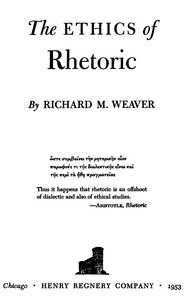
This digital edition of The ethics of rhetoric — Context and Discussion is described by source-level measurements including 80,866 words, 5 hr 52 min estimated reading time, and 15 detected text sections.
The text analysis averages about 24.9 words per sentence, while the detected sections provide another way to judge how the source is divided.
Project Gutenberg metadata also associates the work with “Public speaking,” connecting these edition facts with the source record’s subject description.
Explore this collection
These alternatives are selected using recorded categories and estimated reading time.
About 367 minutes
Logic
84,225 recorded words. 15 minutes difference from this book's estimate.
View Gutenberg source #42930About 277 minutes
Logic
63,645 recorded words. 75 minutes difference from this book's estimate.
View Gutenberg source #14586About 224 minutes
Logic
51,464 recorded words. 128 minutes difference from this book's estimate.
View Gutenberg source #1722Search stored excerpts and compare books → Choose by your preferences →
Choices use stored catalog measurements. Estimates vary with reading speed. A shared category is a catalog label, not a claim that two books have the same argument or literary quality.
Search reads excerpt text stored with this catalog and links to its associated Gutenberg record. The connection is stored in the site database; this tool does not recheck that every excerpt is word-for-word identical to that external record. Excerpt search does not cover every chapter and does not verify historical publication dates.
Catalog snapshot checked: 2026-09-26. Coverage: 98 public books, 98 available source excerpts.
Calculated from edition completeness, EPUB availability, text structure and catalogue metadata. Not a user rating.
Total of 100 points, scaled to a 2.5-5.0 range. Editions with an empty description or a missing EPUB file are not scored.
Public-domain source text
The source text is kept in the dedicated reader, separate from this catalogue record and its commentary.
Weaver opens his study by confronting the difficulty of defining the question Plato's Phaedrus was meant to answer, noting that students have felt uncertain of its unity of theme. He argues that the dialogue is consistently about the nature of rhetoric, a point missed because most readers conceive rhetoric as a system of artifice rather than an idea. This sets the stage for Weaver's own method: he treats rhetorical forms as carriers of ethical content, not mere technique.
Weaver contends that the Phaedrus, despite its apparent divagation through love, the soul, speechmaking, and composition, is consistently about one thing: the nature of rhetoric. He suggests that a literal and topical reading has obscured this unity. By bringing imagination to the text, one perceives that Plato's dialogue keeps very close to the idea of rhetoric as an ethical pursuit. Weaver's own analysis mirrors this approach, treating rhetoric not as a set of tricks but as a mode of thought with moral implications.
Weaver examines the rhetorical effects of grammatical categories, focusing on the adjective and adverb. He proposes a rule that the substantive typically receives major attention over the adjective, but admits exceptions when intonation, semantic clash, or exciting associations shift focus. For the adverb, he notes its superior mobility and its role as a word of judgment, often expressing subjective feeling. Contrasting Carlyle's explosive adverbs with Henry James's scrupulous ones, Weaver shows how adverbial choices shape a writer's ethical stance.
Weaver analyzes two rhetorical strategies through historical figures: Edmund Burke's argument from circumstance and Abraham Lincoln's argument from definition. Burke's approach emphasizes the particular situation, while Lincoln's appeals to fixed principles. This dichotomy reflects deeper ethical commitments—whether one prioritizes the immediate context or transcendent ideals. Weaver's treatment suggests that rhetorical choices are never neutral; they embody a speaker's worldview and moral priorities.
In later chapters, Weaver turns to the rhetoric of social science and what he calls "ultimate terms"—words like "fact" or "progress" that carry persuasive force beyond their literal meaning. He argues that social science often masks its rhetorical nature behind claims of objectivity. By exposing the persuasive strategies embedded in such discourse, Weaver reinforces his central thesis: rhetoric is inseparable from ethics, and every utterance makes a moral claim.
Weaver's book rewards readers who attend to the interplay between grammatical form and ethical argument. His close reading of the Phaedrus and his contrasts between Burke and Lincoln offer concrete models for analyzing rhetoric as a moral act. The work is best approached not as a manual but as a series of demonstrations that language choices reveal a speaker's deepest commitments.
Rereading The Ethics of Rhetoric, I kept circling back to how Weaver ties our spoken choices to hidden moral leanings. It felt oddly like remembering an old conversation about intuition—how we somehow know before we articulate. That quiet, unprovable sensing stayed with me, and for some reason it drifted toward The Sixth Sense: Its Cultivation and Use — Story, Setting & Ideas, where that same inner knowing is treated as something tender and learnable.
Build a private reading journal entry for this title.