About 157 minutes
Animals' Rights Considered in Relation to Social Progress — Key Ideas to Explore
Logic
35,922 recorded words. 0 minutes difference from this book's estimate.
View Gutenberg source #64498
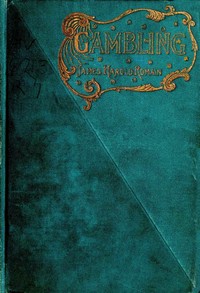
Gambling; or, Fortuna, her temple and shrine. The true philosophy and ethics of gambling — Context and Discussion can be approached with a clearer sense of reading commitment from its source measurements: 35,926 words, 2 hr 37 min estimated reading time, and 11 detected text sections.
The text analysis averages about 19.6 words per sentence, while the detected sections provide another way to judge how the source is divided.
Project Gutenberg metadata also associates the work with “Gambling,” connecting these edition facts with the source record’s subject description.
Explore this collection
These alternatives are selected using recorded categories and estimated reading time.
About 157 minutes
Logic
35,922 recorded words. 0 minutes difference from this book's estimate.
View Gutenberg source #64498About 96 minutes
Logic
21,910 recorded words. 61 minutes difference from this book's estimate.
View Gutenberg source #59091About 224 minutes
Logic
51,464 recorded words. 67 minutes difference from this book's estimate.
View Gutenberg source #1722Search stored excerpts and compare books → Choose by your preferences →
Choices use stored catalog measurements. Estimates vary with reading speed. A shared category is a catalog label, not a claim that two books have the same argument or literary quality.
Search reads excerpt text stored with this catalog and links to its associated Gutenberg record. The connection is stored in the site database; this tool does not recheck that every excerpt is word-for-word identical to that external record. Excerpt search does not cover every chapter and does not verify historical publication dates.
Catalog snapshot checked: 2026-09-26. Coverage: 98 public books, 98 available source excerpts.
Calculated from edition completeness, EPUB availability, text structure and catalogue metadata. Not a user rating.
Total of 100 points, scaled to a 2.5-5.0 range. Editions with an empty description or a missing EPUB file are not scored.
Public-domain source text
The source text is kept in the dedicated reader, separate from this catalogue record and its commentary.
The book opens with a striking allegorical preface: two knights in burnished mail encounter a bronze statue of Victory, each seeing the shield as a different metal—gold to one, silver to the other. This fable of perspective sets the stage for Romain’s central argument that gambling’s morality depends on viewpoint. The work is structured as a temple and shrine to Fortuna, the Roman goddess of fortune, with chapters treating gambling as a natural human propensity rooted in heredity and chance. Romain draws on authorities from Galton to Spencer, weaving together philosophy, social science, and history to build his case.
The preface’s knightly encounter is not mere ornament; it establishes the book’s method of argument through analogy and perspective. The shield that appears gold to one knight and silver to the other mirrors the central claim that gambling’s ethical status shifts with the observer’s standpoint. Romain returns to this motif implicitly throughout, treating gambling as a phenomenon that cannot be judged by a single moral standard. The temple-and-shrine structure—with Fortuna as the presiding deity—gives the work a ritualistic, almost architectural organization. Each chapter functions as a chamber in this temple, moving from the nature of chance to the heredity of the gambling instinct.
Romain leans heavily on the astronomer Richard A. Proctor’s argument that chance has shaped human nature over countless generations. He quotes Proctor at length: “the element of chance which enters into all lives, has had a most potent influence in moulding the characters of men.” The text traces this influence from savage hunters who “ran on speculation” to modern businessmen who depend on luck. Romain extends this to argue that the gambling instinct is as natural as temperament or complexion, and that it cannot be deemed immoral simply because it involves risk. The appeal to heredity—citing Galton’s work on genius and the transmission of mental faculties—is central: gambling is an inherited propensity, not a moral failing.
A substantial portion of the argument rests on the idea that mental qualities, including the inclination to gamble, are hereditary. Romain marshals evidence from phrenologists like Fowler and from Galton’s study of illustrious families. He lists traits passed down through generations: “caution, self-esteem, firmness, pride, benevolence, and religious feeling.” The text asserts that “the dead rule over the living,” quoting Spencer, and that past generations transmit their nature bodily and mentally. Romain then applies this to gambling: if the propensity is inherited, it cannot be simply legislated away. The law, he implies, cannot change human nature. This section moves from general heredity to a specific defense of gambling as a natural, not sinful, activity.
The publisher’s note, signed by Adam Craig, frames the book as an exercise in free speech and fair play. Craig admits he has “no sympathy for gambling” but offers the book to the public to decide its correctness. This prefatory material is itself part of the work’s rhetorical structure: it anticipates criticism and positions the author as a scholar, not an apologist. The dedication to John Cameron Simonds, a non-gambler, reinforces this. The book thus opens with a series of frames—the publisher’s disclaimer, the allegorical preface, the dedication—that prepare the reader for a philosophical treatise rather than a polemic. These frames also mirror the temple structure: the reader enters through a series of portals before reaching the inner shrine of argument.
Readers should approach this work as a sustained argument from analogy and heredity, not as a manual or a confession. The temple-and-shrine metaphor is not decorative; it organizes the book’s progression from the nature of chance to the ethics of gambling. Pay attention to how Romain uses authorities—from Proctor to Galton to Spencer—to build a case that gambling is an inherited instinct. The book’s value lies in its systematic attempt to reframe a moral question as a natural one.
Sitting with Gambling’s temple to Fortuna, I kept thinking about how we build our own altars to certainty. The old argument about chance versus divine order feels less like a debate and more like a quiet family quarrel. That led me back to History of the Conflict Between Religion and Science — A Closer Reading, where the same tension hums under every page, unanswered but oddly comforting.
Your answers remain private and are stored only in this browser.