About 70 minutes
A Wonderful Night; An Interpretation of Christmas — Themes and Context
Ethics
15,941 recorded words. 0 minutes difference from this book's estimate.
View Gutenberg source #14629
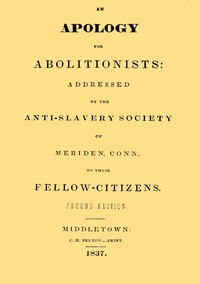
Before opening An apology for abolitionists addressed by the anti-slavery society of Meriden, Conn., to their fellow citizens — Reading Companion, the edition data offers a quick orientation: 16,066 words, 1 hr 10 min estimated reading time, and 5 detected text sections.
The text analysis averages about 23.0 words per sentence, while the detected sections provide another way to judge how the source is divided.
Project Gutenberg metadata also associates the work with “Slavery -- United States,” connecting these edition facts with the source record’s subject description.
Explore this collection
These alternatives are selected using recorded categories and estimated reading time.
About 70 minutes
Ethics
15,941 recorded words. 0 minutes difference from this book's estimate.
View Gutenberg source #14629About 71 minutes
Ethics
16,234 recorded words. 1 minutes difference from this book's estimate.
View Gutenberg source #16986About 65 minutes
Ethics
14,733 recorded words. 5 minutes difference from this book's estimate.
View Gutenberg source #16624Search stored excerpts and compare books → Choose by your preferences →
Choices use stored catalog measurements. Estimates vary with reading speed. A shared category is a catalog label, not a claim that two books have the same argument or literary quality.
Search reads excerpt text stored with this catalog and links to its associated Gutenberg record. The connection is stored in the site database; this tool does not recheck that every excerpt is word-for-word identical to that external record. Excerpt search does not cover every chapter and does not verify historical publication dates.
Catalog snapshot checked: 2026-09-26. Coverage: 98 public books, 98 available source excerpts.
Calculated from edition completeness, EPUB availability, text structure and catalogue metadata. Not a user rating.
Total of 100 points, scaled to a 2.5-5.0 range. Editions with an empty description or a missing EPUB file are not scored.
Public-domain source text
The source text is kept in the dedicated reader, separate from this catalogue record and its commentary.
The Anti-Slavery Society of Meriden, Connecticut, opens this 1837 pamphlet by directly addressing their fellow citizens, stating that opposition to abolition arises from “commercial, political or domestic connections with Slavery, or from misapprehensions respecting our principles, measures and prospects.” The authors—Philo Pratt, Walter Webb, and Isaac Tibbals—do not merely assert moral outrage; they construct a layered defense that blends republican ideology, Christian obligation, and pragmatic self-interest. The text is structured as a public letter, beginning with a formal “Declaration of Sentiments” that enumerates eight core beliefs, each phrased as a declarative article. This opening section establishes the pamphlet’s rhetorical strategy: to reframe abolition not as radical interference but as a lawful, constitutional, and religious duty.
The pamphlet’s “Declaration of Sentiments” reads like a catechism of abolitionist principles. Each article begins with “We believe,” creating a collective voice that asserts moral certainty. The first article echoes the Declaration of Independence: “all men are born free and equal, and endowed by their Creator with certain inalienable rights.” Subsequent articles declare slavery “under all circumstances sinful,” a “great national evil,” and argue that “immediate abolition would be safe and wise.” Notably, the declaration carefully limits federal power, stating that Congress may abolish slavery only in the District of Columbia and territories, and that state legislatures alone can abolish it within their borders. This legal precision counters the charge that abolitionists sought unconstitutional federal overreach. The declaration also affirms the right to publish opinions on “customs and institutions” of any country, framing abolitionist speech as protected expression.
The authors argue that slavery harms the North directly, using the metaphor of a “moral pestilence” that “throws back upon us” intemperance, licentiousness, and infidelity. They claim slavery “casts an undeserved stigma on manual labor” and “encourages idleness and prodigality.” To illustrate the corrosive effect, they pose a hypothetical: “What would become of the virtue, intelligence and religious institutions of Meriden, if all the real estate and all the inhabitants of the town, were held as property by one man?” This local analogy makes the abstract evil tangible. The pamphlet also contends that abolition would benefit Northern commerce: emancipated slaves would become consumers of Northern goods, and Northern youth could compete in cotton cultivation “without becoming slave-holders.” The argument thus merges moral urgency with economic self-interest, a pragmatic appeal to the pamphlet’s intended audience.
The authors reject the claim that Northerners have no right to criticize Southern slavery, invoking the motto “Our country is the world, our countrymen mankind.” They compare their concern to sympathy for Greek and Polish struggles against despotism, and for the “moral and political degradation of the Hindoo, Hottentot and Chinese.” The pamphlet then details how slavery corrupts Southern religion: it creates a “destitution of the means of religion,” fosters “the worst passions” in masters, and renders preaching “inefficacious with all classes.” The text lists four groups affected—masters, poor whites, free people of color, and slaves—each with specific spiritual harms. For slaves, slavery “robs them of the bible, of self-control, of hope, of parent, wife and child.” This section grounds the abolitionist cause in evangelical Christian responsibility, framing it as a mission to save souls as well as bodies.
Readers should note that this pamphlet represents a local society’s attempt to persuade neighbors, not a national manifesto. The authors repeatedly stress lawful means and constitutional limits, distinguishing their position from more radical abolitionist voices of the era. The text’s structure—a declaration followed by reasoned argument—mirrors the legal and religious rhetoric common to antebellum reform. Pay attention to how the authors balance moral absolutism with pragmatic appeals, and how they use the first-person plural to create a unified community voice. The pamphlet is best understood as a specimen of grassroots political theology, arguing that Christian duty and civic health are inseparable.
There’s something humbling in how those Meriden voices, so certain of their moral ground, still sound unsure of being heard. I found myself thinking of that quiet persistence while reading The Human Machine — Reading Companion, where duty becomes less a shout and more a steady, ordinary pulse. Both leave you with a strange, gentle ache for convictions we once held so simply.
Your answers remain private and are stored only in this browser.









