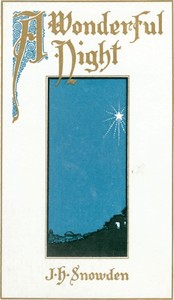
James H. Snowden's A Wonderful Night; An Interpretation of Christmas (1919) builds its argument through a series of paired contrasts: ancient and modern wonders, shepherds and scholars, the humble manger and the imperial throne. The book's structure moves from the historical events of the first Christmas to their enduring significance, a pattern evident in the chapter titles that alternate between narrative scenes—"The Town of Bethlehem," "Angels and Shepherds"—and interpretive reflections such as "Was a Child the Best Christmas Gift to the World?" and "Has the Christmas Song Survived the World War?"
Contrast as Structural Principle
Snowden repeatedly sets up oppositions to drive his points home. The opening chapter, "An Age of Wonders," compares the rapid-fire marvels of the early twentieth century—"shooting stars" and "the Great War"—with the wonders of earlier eras, including the Reformation and the discovery of America. This framing allows him to argue that the birth of Christ, though ancient, remains the supreme wonder. Later, he contrasts the rich and the great with the lowly: "No one can ever save the world by winning over the rich and the great." The gospel, he insists, works from beneath, lifting the peasant before the prince. This rhetorical strategy of juxtaposition gives the book a clear, almost sermon-like rhythm, each contrast reinforcing the central claim that the Christmas story inverts worldly hierarchies.
Recurring Images of Light and Movement
Light imagery pervades the excerpts. The night of Christ's birth is "starred with the Birth of Bethlehem"; a new star "glittered upon the blazing curtain of the night"; and the wise men follow a "celestial messenger." Snowden also uses verbs of motion to convey spiritual and historical momentum: the birth "created a new center for the world and set heaven and earth revolving around his cradle." The wise men "overleaped their national piety and patriotism and prejudice" to journey across "long burning stretches of desert sand." This language of light and travel suggests a dynamic, almost gravitational pull toward the manger, reinforcing the idea that the event reorients everything in its orbit.
Movement Between Narrative and Reflection
The book alternates between recounting the biblical story and drawing contemporary lessons. Chapter titles like "The Birth" and "No Room in the Inn" signal narrative passages, while "A World Without Christmas" and "The Light of the World" indicate reflective sections. In the excerpts, Snowden moves from describing the shepherds' visit to a broader claim: "Christ is saving the world as a whole. He is not slicing the loaf of society horizontally... but he is slicing it vertically." This shift from scene to interpretation is a deliberate structural choice, allowing Snowden to treat the Christmas story not merely as history but as a living model for social and spiritual renewal. The reader is guided from the stable to the modern world and back again.
The Wise Men as a Bridge Between Science and Faith
In the chapter "The Star and the Wise Men," Snowden presents the Magi as exemplars of a harmony between knowledge and reverence. They are "Persian priests, scholars, scientists, astrologers" who find no conflict between their study of the stars and their worship of the newborn king. Snowden writes, "There was no war between the science and the theology of these wise men. Their science did not kill their religion, and their religion did not strangle their science." This passage, written just after World War I, suggests an anxiety about the perceived tension between modern science and faith—a tension Snowden resolves by pointing to the wise men as models. The section also underscores the book's universalist theme: the Magi, though not Jews, recognize the child's divine significance, prefiguring the global reach of the gospel.
The Shepherds and the Social Ladder
Snowden returns repeatedly to the shepherds as a symbol of the gospel's appeal to the lowly. He notes that "it takes some brain to read Plato" but that the gospel offers "milk and honey for his soul" to shepherd and scholar alike. This argument is tied to a broader social vision: "Jesus did not begin with Cæsar, but with shepherds, and then in three hundred years a Christian Cæsar sat on the throne." The shepherds are not merely picturesque figures; they are evidence that Christianity works from the bottom up. Snowden's insistence on this point, supported by the historical claim of Constantine's conversion, gives the book a practical, almost political edge. The manger becomes a lever for social transformation, a theme that resonates with early twentieth-century progressive Christianity.
Readers will find that Snowden's book rewards attention to its structural patterns: the paired contrasts, the recurring images of light and journey, and the movement between past and present. The excerpts suggest a work that is as much about the early twentieth century as about the first Christmas. Approaching the text with an eye to these devices reveals a carefully crafted argument for the enduring relevance of the nativity story, one that invites reflection on how ancient events continue to shape modern faith and society.
I have sat with Snowden’s A Wonderful Night often, struck by how its paired contrasts find their echo in an older text—The Vedanta-Sutras with the Commentary by Sankaracarya Sacred Books of the East, Volume 1 — Inside the Classic. Both weave history and reflection, light moving through the words like a quiet lamp, each commentary a conversation across centuries, unhurried and patient, like this shelf beside me.