About 579 minutes
Evidences of Christianity — Inside the Classic
Ethics
133,154 recorded words. 56 minutes difference from this book's estimate.
View Gutenberg source #14780
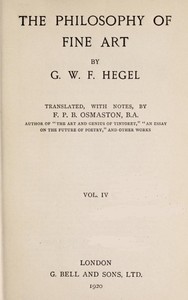
The catalog record for The Philosophy of Fine Art, volume 4 (of 4) Hegel's Aesthetik — Background and Themes provides practical reading context through 145,928 words, 10 hr 35 min estimated reading time, and 14 detected text sections.
The text analysis averages about 33.5 words per sentence, while the detected sections provide another way to judge how the source is divided.
Project Gutenberg metadata also associates the work with “Aesthetics,” connecting these edition facts with the source record’s subject description.
Explore this collection
These alternatives are selected using recorded categories and estimated reading time.
About 579 minutes
Ethics
133,154 recorded words. 56 minutes difference from this book's estimate.
View Gutenberg source #14780About 553 minutes
Ethics
126,967 recorded words. 82 minutes difference from this book's estimate.
View Gutenberg source #14418About 536 minutes
Ethics
123,235 recorded words. 99 minutes difference from this book's estimate.
View Gutenberg source #14636Search stored excerpts and compare books → Choose by your preferences →
Choices use stored catalog measurements. Estimates vary with reading speed. A shared category is a catalog label, not a claim that two books have the same argument or literary quality.
Search reads excerpt text stored with this catalog and links to its associated Gutenberg record. The connection is stored in the site database; this tool does not recheck that every excerpt is word-for-word identical to that external record. Excerpt search does not cover every chapter and does not verify historical publication dates.
Catalog snapshot checked: 2026-09-26. Coverage: 98 public books, 98 available source excerpts.
Calculated from edition completeness, EPUB availability, text structure and catalogue metadata. Not a user rating.
Total of 100 points, scaled to a 2.5-5.0 range. Editions with an empty description or a missing EPUB file are not scored.
Public-domain source text
The source text is kept in the dedicated reader, separate from this catalogue record and its commentary.
Hegel opens his discussion of poetry by declaring it the 'universal art,' capable of rendering 'everything made intelligible by language.' Unlike painting or music, poetry dispenses with external sensuous presence, appealing instead to 'imaginative vision.' This volume, the fourth of Hegel's Aesthetik, focuses entirely on poetry, examining its distinction from prose, its historical evolution, and its three principal forms: epic, lyric, and dramatic. Translator F. P. B. Osmaston, whose notes accompany the text, brings a particular scholarly voice to the English edition, occasionally inserting his own interpretations and cross-references.
Hegel's central claim is that poetry, because it uses language rather than physical materials, can express the 'infinite domain of Spirit' more fully than other arts. He contrasts poetry with painting, which presents a single moment, and music, which relies on tone; poetry alone can display 'facts in their historical succession or natural process.' The material of poetry is the imagination itself, making it 'conjoint with all the arts.' Yet Hegel warns that this very independence marks 'the commencement of the disintegration of Art,' a bridge to religion and philosophy. The translator's note here clarifies that Hegel sees poetry as both the highest art and the point where art begins to yield to conceptual thought.
Hegel devotes substantial attention to epic poetry, using Homer as the 'ne plus ultra' of the form. He praises the Homeric epics for their 'primitive masculine heroes' and 'naïveté' of divine-human interaction. In contrast, later Greek cyclic poets 'break up the completeness of the national world-survey,' and Roman epic, exemplified by the Aeneid, is already 'half prose.' Hegel argues that epic requires a 'change in its outlook on the world' to be revitalized, as seen in Germanic and Romance traditions after Christianity. He controversially discusses the Ossianic poems, asserting that Macpherson could not have invented them entirely—a claim that reflects 19th-century debates about authenticity.
Osmaston's translation choices and notes actively shape the reader's experience. He inserts bracketed summaries and clarifications, such as the note that poetry's 'affinity with and distinction from pure thought' is a key Hegelian distinction. His language occasionally carries a Victorian formality—'the ideal rationale of fact is aimed at by poetry'—which may affect the rhythm of Hegel's argument. Osmaston also provides cross-references to his own works, like The Art and Genius of Tintoret, signaling his own scholarly investments. Readers should attend to these editorial interventions, as they sometimes interpret Hegel's meaning rather than simply rendering it.
Hegel's own diction in this volume is notably abstract and categorical. He repeatedly uses terms like 'finite categories of the understanding' and 'ideal envisagement,' contrasting poetic 'imaginative grasp' with prosaic 'thinking.' The excerpts show a preference for triadic structures: epic, lyric, dramatic; ancient, medieval, modern; Greek, Roman, Germanic. This structural habit reflects Hegel's dialectical method. Osmaston's translation preserves these patterns but occasionally introduces Latinate vocabulary that distances the English from Hegel's German. For instance, 'envisagement' for Anschauung is a choice that emphasizes intellectual vision over sensory intuition.
This volume rewards readers who attend to both Hegel's systematic claims and Osmaston's mediating presence. The discussion of epic poetry, with its judgments on Homer, Ossian, and national character, offers a window into 19th-century aesthetic theory. For those new to Hegel, starting with the section on poetry's distinction from prose may clarify his method. The translator's notes, while occasionally intrusive, also provide useful signposts through the dense argumentation.
There’s a particular quietness in Hegel’s final volume, a sense of poetry holding every other art together, that reminds me of an older, calmer sort of reading. It feels like returning to a well-worn page in Occasional Thoughts in Reference to a Vertuous or Christian life — Reading Companion, where the prose asks for patience, not speed. Both leave a lingering hum, like a familiar bell.
Save your reaction, strongest insight, and memorable passage.









