About 261 minutes
The Man from Mars: His Morals, Politics and Religion — Edition Insights
Ethics
59,889 recorded words. 0 minutes difference from this book's estimate.
View Gutenberg source #56979
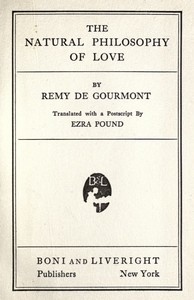
This digital edition of The Natural Philosophy of Love — Context and Discussion is described by source-level measurements including 59,929 words, 4 hr 21 min estimated reading time, and 6 detected text sections.
The text analysis averages about 22.1 words per sentence, while the detected sections provide another way to judge how the source is divided.
Project Gutenberg metadata also associates the work with “Reproduction,” connecting these edition facts with the source record’s subject description.
Explore this collection
These alternatives are selected using recorded categories and estimated reading time.
About 261 minutes
Ethics
59,889 recorded words. 0 minutes difference from this book's estimate.
View Gutenberg source #56979About 266 minutes
Ethics
60,954 recorded words. 5 minutes difference from this book's estimate.
View Gutenberg source #17274About 255 minutes
Ethics
58,568 recorded words. 6 minutes difference from this book's estimate.
View Gutenberg source #44644Search stored excerpts and compare books → Choose by your preferences →
Choices use stored catalog measurements. Estimates vary with reading speed. A shared category is a catalog label, not a claim that two books have the same argument or literary quality.
Search reads excerpt text stored with this catalog and links to its associated Gutenberg record. The connection is stored in the site database; this tool does not recheck that every excerpt is word-for-word identical to that external record. Excerpt search does not cover every chapter and does not verify historical publication dates.
Catalog snapshot checked: 2026-09-26. Coverage: 98 public books, 98 available source excerpts.
Calculated from edition completeness, EPUB availability, text structure and catalogue metadata. Not a user rating.
Total of 100 points, scaled to a 2.5-5.0 range. Editions with an empty description or a missing EPUB file are not scored.
Public-domain source text
The source text is kept in the dedicated reader, separate from this catalogue record and its commentary.
The table of contents immediately signals that this is not a conventional treatise. Gourmont organizes his inquiry into chapters with titles such as 'The Subject of an Idea', 'The Aim of Life', and 'Scale of Sexes', moving from general psychology to specific anatomical and behavioral comparisons across the animal kingdom. The opening excerpt declares that love will be examined 'according to natural laws', with a stated aim to demonstrate the 'identity of human and animal psychology'. This sets an expectation for a work that is both philosophical and empirical, drawing on natural history rather than moral or religious frameworks.
The book is divided into numbered chapters, each addressing a distinct aspect of reproduction. The early chapters establish a broad framework: 'The Aim of Life' asserts the 'ineluctable character' of the sexual act, while 'Scale of Sexes' introduces asexual reproduction, hermaphrodism, and parthenogenesis. Later chapters narrow to specific groups—invertebrates, vertebrates, and finally humans—under the heading 'Sexual Dimorphism'. This progression from general principles to detailed examples gives the reader a clear path from abstract concepts to concrete observations. The translator, Ezra Pound, adds a postscript, though its content is not revealed in the excerpts.
The middle excerpts shift from theoretical claims to vivid natural history. Gourmont describes the mating behavior of the white-fronted dectic, a grasshopper, drawing on the entomologist J. H. Fabre. He notes the 'opaline leather bottle' spermatophore, the female chewing and swallowing it, and the male's subsequent death. The prose is precise and unflinching: 'the female looks at him, smells him, takes a bite of his thigh.' Such passages ground the earlier generalizations in specific, often startling, examples. The reader encounters not just abstract 'dimorphism' but the actual mechanics of courtship, copulation, and cannibalism in insects.
Gourmont repeatedly cites Fabre's Souvenirs Entomologiques, using his detailed accounts as evidence. For instance, the description of the dectic's mating includes direct quotation: 'It is an opaline leather bottle about the size and colour of a mistletoe berry.' This reliance on a single observer gives the text a distinctive texture—it is both a synthesis of scientific knowledge and a personal meditation on Fabre's findings. The excerpts do not reveal whether Gourmont conducted his own observations, but the frequent invocation of Fabre suggests that the book is as much a commentary on entomological literature as a standalone argument.
Gourmont's tone is detached yet engaged. He refers to 'the apparent immorality of Nature' and describes a cannibal female as 'a fine type of beast', but avoids moral judgment. Instead, he emphasizes 'the serenity of nature, which permits all things'. This rhetorical stance invites the reader to observe without prejudice. The writing is dense with specific terminology—'spermatophore', 'oviscapte', 'parthenogenesis'—yet the excerpts show that Gourmont explains these terms through context. The effect is a work that demands careful reading but rewards with a cumulative understanding of reproductive diversity.
Readers approaching this book for the first time should attend to the interplay between its systematic chapter structure and the vivid, often unsettling, natural history vignettes. The excerpts suggest that Gourmont's argument builds through accumulation of examples rather than linear deduction. Pay particular attention to the footnotes and citations, especially to Fabre, as they anchor the philosophical claims in observable phenomena. The translation by Ezra Pound adds a layer of stylistic choice—Pound's idiom may color the original French, but the excerpts do not allow comparison.
I finished Gourmont’s book feeling oddly tender toward the whole messy business of living, how every creature just stumbles through it. That same quiet acceptance came back reading The Pleasures of Life—not answers, just company. I kept it on my nightstand for weeks, like a friend who doesn’t need you to say anything. The Pleasures of Life — Inside the Classic feels like that too.
Your answers remain private and are stored only in this browser.









