
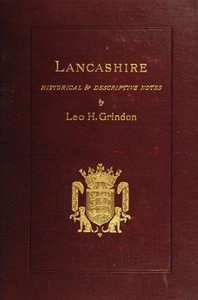
Lancashire: Brief Historical and Descriptive Notes by Leo H. Grindon
First published in 1892, Leo H. Grindon's book is less a straight narrative and more a loving, detailed portrait of a county at a crossroads. Grindon was a naturalist and writer with a deep affection for his subject, and he uses that passion to guide the reader.
The Story
There isn't a single plot, but a journey. Grindon acts as our companion, walking us through Lancashire's layers. He starts with the ancient foundations—the Celts, the Romans, the Normans—showing us the old stones and earthworks that hint at its early story. Then, he moves into what made Lancashire legendary: the Industrial Revolution. He takes us into Manchester, Liverpool, and the mill towns, explaining not just the factories and machines, but the people, the canals, and the sheer explosive energy of the place. Woven throughout are vivid descriptions of the natural landscape that persisted—the Pennine hills, the coastal marshes, and the quiet valleys that existed alongside the booming cities.
Why You Should Read It
What makes this book special is Grindon's voice. He's not a detached historian; he's a local showing off his home, proud of its achievements but also keenly aware of what was being lost. His descriptions of a smoky Manchester sunset or the quiet of a rural churchyard are genuinely beautiful. You get a sense of a man trying to hold onto the soul of a place even as he marvels at its world-changing power. It's this personal touch that lifts the book from a simple guide to a poignant snapshot. You're seeing the birth of our modern world through the eyes of someone who lived it, with all its awe and its cost.
Final Verdict
This is a gem for anyone with roots in or curiosity about Northern England. It's perfect for local history fans, people interested in the real, human side of the Industrial Revolution, or travelers who want to understand the deep history behind the places they visit. Because it's written in clear, descriptive prose, it's very accessible. Just don't expect a slick, modern history book; expect a thoughtful, sometimes meandering, and always earnest tour with a knowledgeable and passionate guide. It's a window into a lost world, held open by a writer who loved it.
This title is part of the public domain archive. It is available for public use and education.
Karen Martin
1 year agoThis was exactly the kind of deep dive I was searching for, the practical checklists included are a great touch for real-world use. Well worth the time invested in reading it.
Patricia Johnson
1 month agoA must-have for graduate-level students in this discipline.
Christopher Anderson
9 months agoBefore I started my latest project, I read this and the structural organization allows for quick referencing of key points. This is a solid reference for both beginners and experts.
Linda Jackson
1 year agoA sophisticated analysis that fills a gap in the literature.



Ashley Johnson
3 months agoThe digital index is well-organized, making research much faster.