
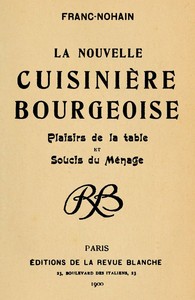
La nouvelle cuisinière bourgeoise: Plaisirs de la table et soucis du ménage
Published in 1909, La nouvelle cuisinière bourgeoise presents itself as a practical manual. Its full title translates to 'The New Bourgeois Cook: Pleasures of the Table and Household Worries,' which perfectly sums up its split personality. The book is structured as a series of chapters and advice columns for the lady of a middle-class home.
The Story
There isn't a traditional plot with characters. Instead, the 'story' is the daily life of a French bourgeois household at the turn of the 20th century, as told by the witty and somewhat conflicted Franc-Nohain. One chapter will meticulously detail the correct way to polish furniture or haggle with the butcher to save a few centimes. The next will dreamily instruct you on composing a menu for a stylish dinner party, complete with witty conversation topics. The book juggles the gritty reality of managing coal stoves and stubborn stains with the idealized vision of elegant entertaining. It's a guide to surviving and thriving in a world with strict social rules, where your reputation could hinge on the quality of your consommé or the behavior of your staff.
Why You Should Read It
I loved this book because it's a personality in print. You can hear Franc-Nohain's voice—part stern advisor, part amused observer. He doesn't just tell you to make a good stew; he philosophizes about the importance of domestic harmony. Reading it feels like eavesdropping on a very specific moment in history. You get the pressures (financial, social) and the small joys (a perfectly set table, a complimented dish) of a world that's long gone. It's surprisingly relatable in its core dilemma: how do we find beauty and pleasure in the mundane work of everyday life? The book's constant tension between duty and delight is something anyone who's ever planned a party on a budget will understand.
Final Verdict
This is a gem for food history nerds, Francophiles, and anyone who enjoys social history told through everyday objects and routines. It's not a page-turning novel, but a book to dip into. You'll find hilarious and poignant advice that highlights how much—and how little—has changed. Perfect for readers who loved the atmosphere of books like 'The Gentle Art of Domesticity' or the historical context of 'Consider the Fork,' but want a primary source with a lot of quirky charm.
This historical work is free of copyright protections. You can copy, modify, and distribute it freely.
Michael Perez
2 years agoFinally found a version that is easy on the eyes.
Mary Smith
11 months agoAfter a thorough walkthrough of the table of contents, the concise summaries at the end of each section are a lifesaver. Definitely a five-star contribution to the field.
Barbara Martin
1 year agoThe layout is perfect for tablet and e-reader devices.
Karen Johnson
9 months agoThe layout of the digital version made it easy to start immediately, the insights into future trends are particularly thought-provoking. I’ll definitely be revisiting some of these chapters again soon.









Michael Hernandez
11 months agoGreat value and very well written.