
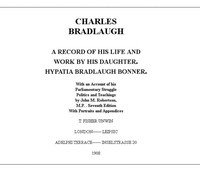
Charles Bradlaugh: a Record of His Life and Work, Volume 1 (of 2) by Bonner et al.
So, who was Charles Bradlaugh? This book, the first of two volumes, tries to answer that by tracking his life from his birth in 1833 up through the massive political storm of his repeated attempts to enter Parliament. It’s not a simple birth-to-death timeline. Instead, it zeroes in on how a boy from a poor background became a self-taught legal expert, a powerful public speaker, and a publisher who constantly danced on the edge of the law.
The Story
The core of the story is Bradlaugh's epic battle with authority. He was a secularist and a republican (meaning he opposed the monarchy) in Victorian Britain, which made him public enemy number one for many. The book shows him publishing controversial pamphlets, getting sued for blasphemy, and rallying huge crowds of working people. The main event, though, is his campaign to become a Member of Parliament for Northampton. He wins the election, but when he shows up to swear in, he refuses to take the religious oath required. This starts a years-long constitutional crisis. Parliament bars him. His constituents re-elect him. They bar him again. It becomes a national spectacle about democracy, belief, and who really gets to have a voice.
Why You Should Read It
I picked this up thinking it would be a dry history lesson. I was wrong. Bradlaugh’s life is incredibly dramatic. Here’s a man facing down judges, angry mobs, and sneering politicians with nothing but his intellect and sheer stubbornness. The book does a great job of making you feel the tension of the era. You get his brilliant legal arguments, but you also see the personal cost—the threats, the financial struggles, the strain on his family. It makes you ask big questions that are still relevant: How much should your personal beliefs matter in public office? What happens when the law conflicts with what’s right?
Final Verdict
This is a perfect read for anyone who loves stories about underdogs and political rebels. If you enjoyed biographies of figures like Thomas Paine or movies about principled stands against the system, you’ll find a lot to love here. It’s also great for understanding the roots of modern secularism and free speech debates. Fair warning: it was written in 1895, so the language is a bit formal in places, but the drama of Bradlaugh’s fight cuts right through. It’s a powerful reminder that the freedoms we argue about today were won by people who fought much harder battles yesterday.
This text is dedicated to the public domain. Use this text in your own projects freely.
Kevin Williams
1 year agoI had low expectations initially, however the clarity of the writing makes this accessible. I learned so much from this.
Donna Martin
1 year agoLoved it.
Joseph Martin
1 year agoIf you enjoy this genre, it manages to explain difficult concepts in plain English. Highly recommended.
David Wright
11 months agoSurprisingly enough, it challenges the reader's perspective in an intellectual way. One of the best books I've read this year.
George Anderson
10 months agoI've been looking for a reliable source on this topic, and the nuanced approach to the central theme was better than I expected. Thanks for making such a high-quality version available.