
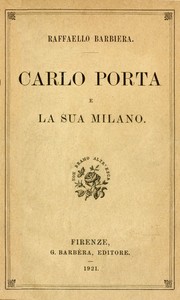
Carlo Porta e la sua Milano by Raffaello Barbiera
Okay, let's clear something up first. If you're expecting a dry, chronological biography of the poet Carlo Porta, you might be surprised. Raffaello Barbiera's book is something much livelier. It's more like being guided through a portrait gallery, but instead of paintings, each frame is a moment, a person, or a corner of Milan that breathed life into Porta's work.
The Story
The book doesn't have a plot in the novel sense. Instead, it builds a world. Barbiera starts with Porta himself—a civil servant by day, a genius poet by night—and then fans out. He introduces us to the city under Austrian rule, a place of strict hierarchies but bubbling with local spirit. We meet the characters from Porta's poems not as literary inventions, but as reflections of real people: the cunning Marchionn di gamb avert (the lame innkeeper), the sharp-tongued nuns, the hopeless romantics. The 'story' is how Porta captured their voices in Milanese dialect, turning local gossip and daily struggles into timeless comedy and social commentary. Barbiera connects the poems to the cafes where they were read aloud, the political tensions they whispered about, and the universal human flaws they poked fun at.
Why You Should Read It
I loved this because it made a distant time and place feel familiar. Porta, through Barbiera's eyes, isn't a marble statue. He's a guy listening to his neighbors, getting annoyed by pompous officials, and finding the perfect funny, gritty word to describe it all. The book is a celebration of local identity. It argues that the soul of a city isn't in its monuments, but in its language and its people's stories. Reading it, you feel you understand why Milanese people might cherish their dialect; it's a badge of belonging, a shared code. It's also surprisingly funny! Barbiera quotes enough of Porta's poems that you get the punchlines, even in translation, and you start to see the mischievous wit that made him a folk hero.
Final Verdict
This is a perfect pick for a specific kind of reader. If you're a traveler at heart who loves digging into a city's culture beyond the guidebooks, you'll adore this deep dive. It's also great for anyone interested in how art comes from everyday life, or who enjoys social history told through vibrant characters, not just dates. You don't need to know a word of Italian or Milanese to appreciate it. Think of it as a friendly, insightful tour of a lost Milan, with one of its greatest wits as your guide. Just be warned: it might make you want to book a trip to Italy and hunt for the echoes of Porta's world in the modern city.
The copyright for this book has expired, making it public property. Thank you for supporting open literature.
Mary Taylor
2 years agoMy first impression was quite positive because the way it challenges the status quo is both daring and well-supported. This should be on the reading list of every serious professional.
Patricia Johnson
11 months agoBefore I started my latest project, I read this and the quality of the diagrams and illustrations (if applicable) is top-notch. Definitely a five-star contribution to the field.
Sarah White
2 years agoAs a professional in this niche, the formatting on mobile devices is surprisingly crisp and clear. Definitely a five-star contribution to the field.
Joseph Miller
6 months agoThe formatting on this digital edition is flawless.



Emily Wilson
1 year agoI stumbled upon this title during my weekend research and the formatting on mobile devices is surprisingly crisp and clear. I appreciate the effort that went into this curation.