
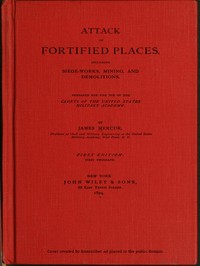
Attack of Fortified Places. Including Siege-works, Mining, and Demolitions.
Let's be clear from the start: 'Attack of Fortified Places' is not a novel. You won't find a dashing hero or a doomed romance within its pages. What you will find is something arguably more compelling for the right reader: a precise, technical field manual from 1888 on how to destroy the strongest structures ever built by humans.
The Story
There's no traditional plot. Instead, the 'story' is one of relentless engineering and physics versus immovable stone and earth. Written by Brigadier General James Mercur for the U.S. Army, the book is a systematic guide to siege warfare. It walks you through the entire process. First, you learn how to approach a fortress under fire. Then, it details the gritty work of 'sapping'—digging protected trenches ever closer to the walls. The most intense sections cover 'mining,' where you dig a tunnel right under the fortress foundations, pack it with gunpowder, and literally blow the wall sky-high. It also covers building siege batteries, breaching walls with artillery, and the final, brutal assault. It's a cold, logical progression from surrounding a place to making it crumble.
Why You Should Read It
This book flipped a switch in my brain. It transforms castles and forts from fairy-tale backdrops into complex engineering puzzles. Reading Mercur's calm, methodical instructions for demolition is oddly chilling. There's a dark brilliance to it. You gain a profound appreciation for the sheer effort and horror of pre-modern warfare. It wasn't just about bravery; it was about math, soil composition, and fuse timing. The book also offers a raw look at 19th-century military thinking, showing how the U.S. Army was preparing for conflicts that would soon be made obsolete by new technology. It’s a snapshot of a vanishing art.
Final Verdict
This is a niche book, but a brilliant one for that niche. It's perfect for history buffs, military enthusiasts, engineers, and anyone who loves 'how things work' documentaries. If you enjoy poring over detailed diagrams and thinking through complex problems, you'll be captivated. It's also great for writers of historical or fantasy fiction who want real, gritty details for their siege scenes. Approach it not as a storybook, but as a primary source—a toolbox of destruction from a different time. You might be surprised by how quickly you get drawn into the logistics of digging the perfect tunnel or placing the perfect charge.
This historical work is free of copyright protections. It is available for public use and education.
Jessica Jones
1 year agoFrom a researcher's perspective, the author manages to bridge the gap between theory and practice effectively. Simple, effective, and authoritative – what else could you ask for?
Ashley White
3 months agoI found the author's tone to be very professional yet accessible, the practical checklists included are a great touch for real-world use. Simple, effective, and authoritative – what else could you ask for?
Michael Thomas
5 months agoHaving read the author's previous works, the historical context mentioned in the early chapters is quite enlightening. A perfect balance of theory and practical advice.
Donald Miller
5 months agoThe peer-reviewed feel of this content gives me great confidence.






Elizabeth Lopez
1 year agoImpressive quality for a digital edition.